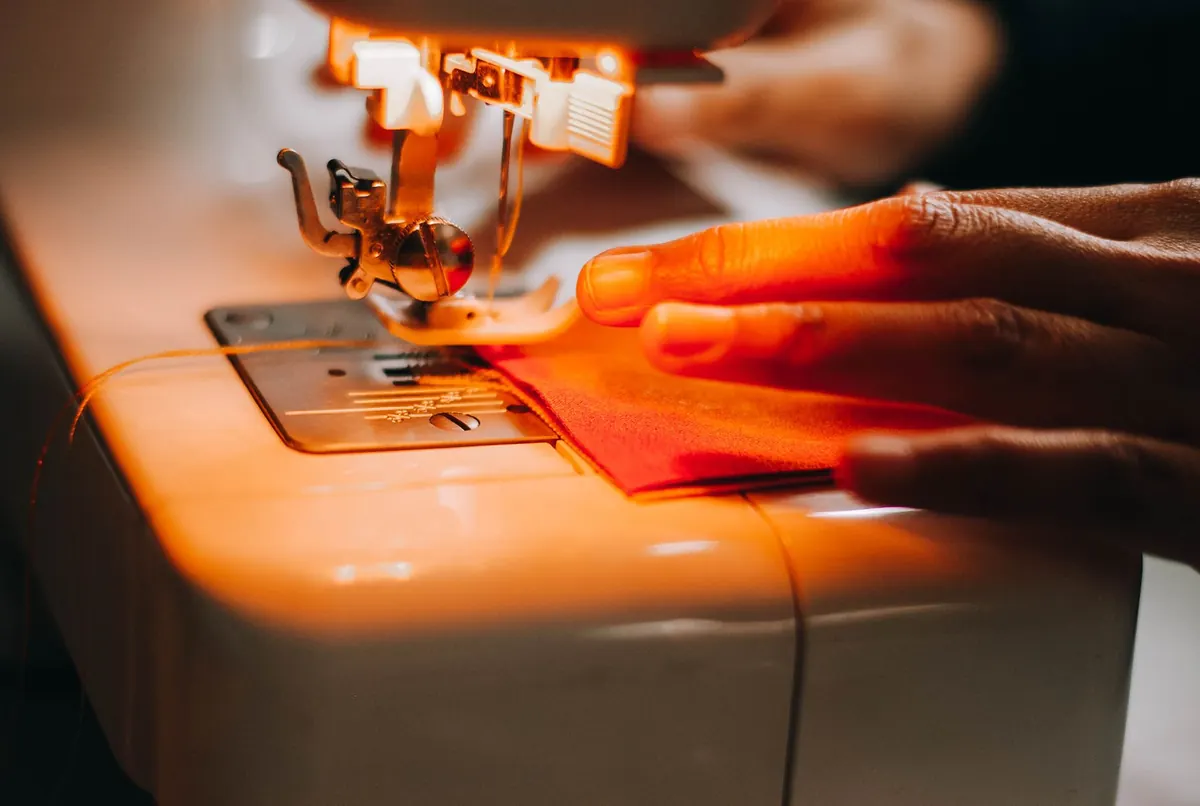
A machine embroidery needle costs pennies and can ruin a whole project in a few hundred stitches. If a design starts cleanly and then shreds its way through the fill stitch, the needle is the first thing worth checking — and the part most often left in the machine from the last job. Getting the size and point right takes five minutes to learn and saves hours of unpicking.
Domestic machines take the 130/705 H needle system: flat shank, with the flat side facing away from you as it goes up into the clamp. Industrial machines use round-shank needles, which photograph almost identically and will not sit properly in a home machine. If a bargain box online does not say 130/705 H, leave it.
Sizes are printed as two numbers — metric first, then the older American (Singer) number. An 80/12 needle has a shaft 0.80 mm across; 12 is the same needle in American sizing. You will meet 60/8, 65/9, 70/10, 75/11, 80/12, 90/14, 100/16 and 110/18 most often. A larger number means a thicker needle, a bigger hole in the fabric and a stronger shaft. Needle length is the same across the whole range, so nothing else about your setup changes.
The size tells you how thick the needle is; the point tells you how it behaves when it meets the fabric. Packets look alike, so read them.
Coated needles, usually titanium, hold their point longer if you regularly stitch dense designs or metallic threads.
Two things decide the size: the weight of the fabric and the weight of the thread. A 40wt embroidery thread — the standard for most designs — sits happily in a 75/11 or 80/12. Fine 60wt threads want a finer needle; 30wt and 12wt want heavier.
Test on a scrap of the actual fabric with the actual stabiliser and a sample of the design. If the thread squeaks, curls or frays as it passes through the eye, go up a size. If the fabric puckers, or the needle leaves holes you can see, go down a size or add more stabiliser underneath. Very fine needles bend and break easily, so do not go finer than the job really needs.
Keep a spare needle of your most-used size taped inside the machine's accessory box. Two minutes of stitching with a blunt or wrong needle can undo an hour of good work.
British shops sell home machine needles in packs of five or boxes of ten, and the packaging normally gives both numbers, so 80/12 and 12/80 are the same needle depending on the brand. Schmetz and Organ are the names you will see most, with Groves and Klasse also common. Assorted packs suit beginners; Schmetz's embroidery assortment, for example, covers 75/11, 80/12 and 90/14.
Look for needles at Hobbycraft and other high street craft shops, in larger stores' haberdashery departments, and from online specialists such as Sew Essential, Jaycotts, Franklins, Barnyarns, Cotton Patch, Empress Mills and William Gee. Groves is a British brand and widely stocked. A box of ten in the size you use most works out cheaper per needle, and they keep for years in a dry tin.
A little translation helps if you follow American tutorials. Their batting is our wadding; their muslin is our calico. Bondaweb is fusible web, and Vilene is the interfacing brand on most UK shelves. Stabiliser is spelled with a z in American patterns and an s in most British shops, but it is the same product.
Change the needle at the start of every project, and after roughly six to eight hours of stitching. Some sewists change it with every bobbin — generous, but never harmful. Metallics, dense designs and abrasive fabrics wear a needle out faster.
Signs a needle has had enough:
If those problems continue with a fresh needle of the right size, check the thread path, the bobbin and the stabiliser before blaming the needle again.
Store spares and part-used needles by size — a tin with masking tape labels, or a needle book with the size written beside each slot — so you are not guessing halfway through a design. Keep a small tin for blunt needles rather than dropping them into household waste, and never leave a loose needle where a hand or a paw might find it.
Photo: rakhmat suwandi / Pexels

A practical ten-point checklist for planning craft room storage, from zoning by activity to clear containers,...

Sewing circles, guilds and workshops exist in most UK towns — you just need to know where to look. Here is how to...
Practical ways to fit a sewing room into a small UK flat, using folding furniture, clever layout and vertical...

Sewing thread storage, organization, and inspiration..
